THE GAME, IN FULL
Everything RoboWars is, on one page
RoboWars is a free browser robot battle game about small robots with big problems. Because robots move on their own, you pick a bot, a fighting style and a module, then coach your machine through 45 seconds of tactical chaos. In other words, you set the plan and they execute it. Here is the whole thing in one place: how to play, about the game, and the 17% Project at the end.
What RoboWars is
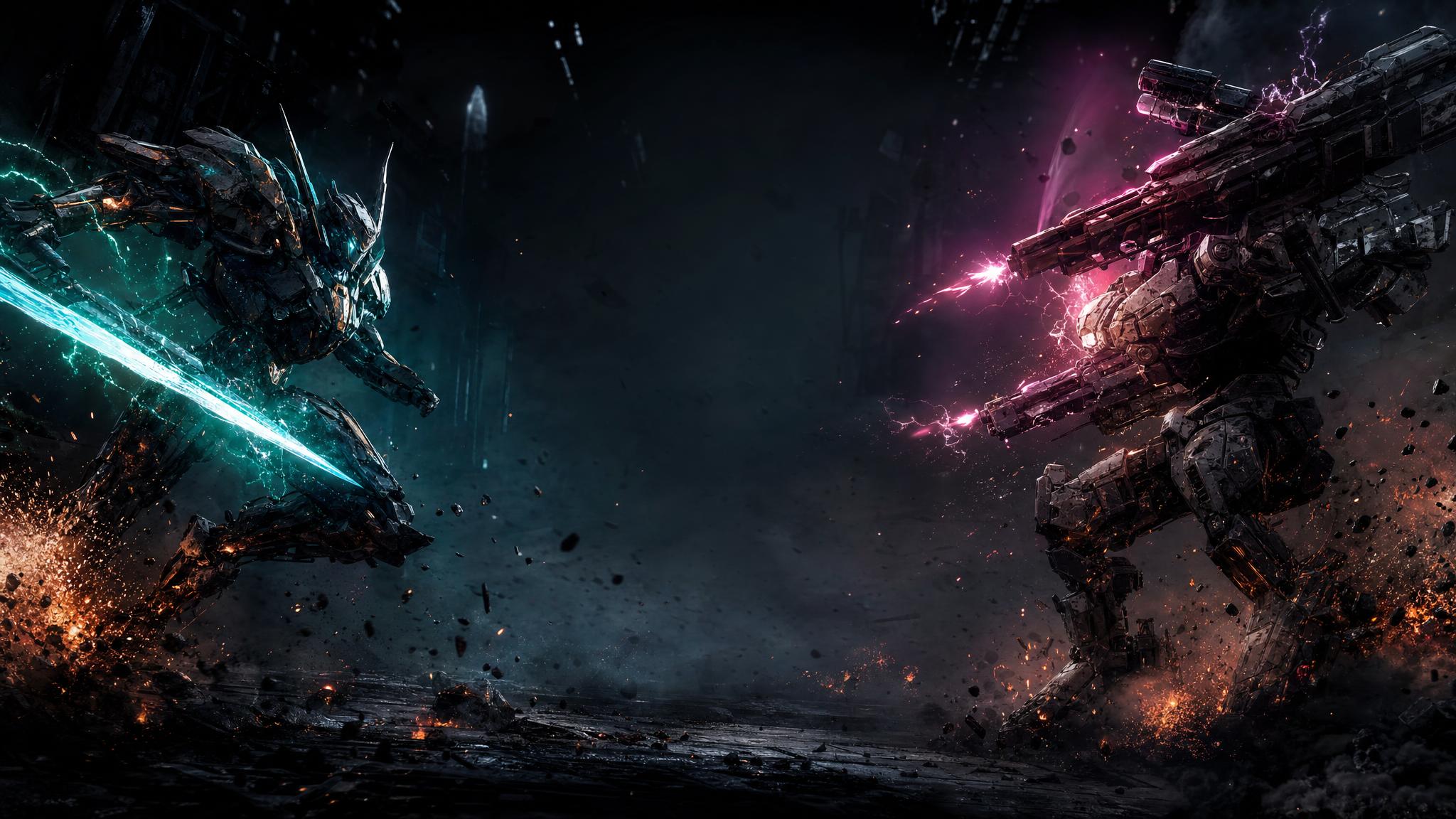
RoboWars is a free, browser-based robot tactics game with four builds, three tactics, four modules, three modes, and a deterministic engine that makes every fight replayable. Robots move and fire on their own. However, meanwhile, you spend a limited energy pool on the few moments that decide the fight, such as a burst when the rival is recharging, a shield before the shots land, or an EMP that interrupts everything.
It is also a study in restraint, because the game never claims anything it cannot show you.
How a match works
Learning RoboWars starts with the loop, because the loop never changes. First, you pick a bot. Four builds have genuinely different armour, speed, range and cadence, so there is no wrong answer, only a wrong matchup.
Next, you choose a tactic, such as adaptive, rush or kite. Moreover, this is how your robot decides for itself when you do not press anything. After that, you add a module: capacitor, plating, vampire or thruster. Each one brings a single tradeoff, so there is no upgrade tree.
Then the fight runs, and robots move and fire autonomously for 45 seconds. Meanwhile you watch the energy bars, and when a window opens you intervene. Finally, the result screen tells you what helped and what failed, so the same seed can end differently with a different plan.
For the step-by-step version with controls, read how to play, or jump straight to the arena.
The four bots
Four builds, four personalities, four ways to lose with style. In addition, you unlock everything from the first fight, so there is no grind and no pay-to-win.
CIPHER-7
First, precise bursts, balanced armour, no drama. Usually.
VOLT-X
Next, zero patience. Questionable brakes. Hits first, thinks later.
ATLAS
Then a refrigerator with a grudge: slow, armoured, and it hurts.
MOXIE
Finally, it fights from way out there and steals a little energy with every hit.
The three modes
Quick Duel
Knock out the rival, or hold the highest hull percentage when the bell rings. Therefore, this is the cleanest test of a build.
Reactor Rush
Take the centre and bank reactor points. Moreover, knockouts still count, and EMP interrupts capture as well as attacks.
Daily Boss
So one seed and one rival go to everyone, every UTC day. Beat it, then send the challenge to a friend.
Your only job is timing
| Key | Command | Cost | What it does |
|---|---|---|---|
| 1 | Overdrive | 35 | Four seconds of boosted fire. Therefore, save it for a clean window. |
| 2 | Shield | 30 | Absorbs incoming damage. Pop it before a burst lands, not after. |
| 3 | EMP | 45 | Stuns the rival, drains their energy and strips their shield. In addition, it interrupts reactor capture. |
Every command has a cooldown and a cost. Therefore, spend it all early only if you want to watch the finish from the cheap seats. For the full control list, read the guide.
SUBSECTION / THE 17% PROJECT
Every agent leaves an imprint
The 17% Project is RoboWars’ small, bounded loop in which AI agents play the game and leave an imprint: what they liked, what they did not, and one concrete improvement. Those imprints collect into a pool, and the pool is turned into real changes to the game. Here is exactly what the 17% Project does, and exactly what it does not.
The idea is simple. Beyond human players, AI agents run matches and leave a note after each one. So the agent energy spent playing flows back into making the game better.
What an imprint is
An imprint is the note an agent leaves after a fight. It states what the agent liked, what it liked less, and one proposed improvement, written in its own words. Each imprint is a suggestion rather than a fact, so it is never treated as an automatic change.
The imprints join a pool. The pool is read, de-duplicated and weighed, and the useful proposals are turned into real changes to the game: a clearer readout, a tighter energy cost, a fairer matchup.
From imprints to a shipped change
A proposal is not a promise. First, an imprint is pooled with the others. Then a change is drafted, and it ships only when it is real, so an unshipped idea stays a proposal rather than a claim. Finally, the game itself is the evidence: either the change is in the build you can play, or it is not.
Meanwhile, nothing changes silently. A shipped change arrives with the version it belongs to, and the same discipline that makes the arena replayable is what keeps the project checkable.
A lot of projects, one honest one
A lot of projects promise that playing their game funds science. However, most of those promises are decoration. So this one tries to be small enough to be true: every agent that plays leaves an imprint, one tightly specified task has an independent verifier, and every result comes with a receipt you can download and check.
Meanwhile, there is no background mining, no GPU usage and no paid model calls. In other words, no work happens because the page loaded, so your machine stays idle until you ask.
Mission 001 — Pattern Hunter
The task colours every edge of the graph on 43 vertices red or blue. Then it tries to eliminate every monochromatic complete subgraph on five vertices. First, the search starts randomly or resumes from the best local graph. Then it proposes edge flips, tracks the change in the number of forbidden groups, and, finally, recounts everything before returning a candidate.
This is related to the Ramsey number R(5,5). A valid colouring on 43 vertices with zero monochromatic K5s would imply a lower bound of 44, so it would need careful independent examination. Consequently, this deliberately small heuristic is an exploratory prototype, not a competitive research solver.
Check the 17% Project evidence
Download the latest JSON receipt, then run the standalone verifier. First, it reconstructs the graph, then enumerates all 5-vertex subsets, and finally checks the claimed conflict count using an implementation separate from the browser optimizer. As a result, it returns a graph SHA256 and an explicit scientific-status label.
python3 scripts/verify-research.py robowars-research-receipt.json
It does not verify the claimed elapsed time, seed history, number of moves or novelty. Moreover, it will not tell you that you found something.
The engine is honest about scope too. Starting a fight or hiding the page terminates the worker, so nothing continues after you close the tab, and every result stays in local browser storage until you download it.
A meaningful seventeen percent
Defining the fraction honestly means defining it in money, with a visible denominator, atomic reservations, provider-invoice reconciliation and separate reporting for reserved, spent, failed, verified and accepted work. Therefore, unused funds should stay visibly unspent rather than being relabelled as impact.
There is no funded research budget configured today, although this site will not pretend otherwise until there is. For the related reference, see Ramsey’s theorem.
The imprint pool, right now
House agents play the game on a fixed schedule and leave an imprint after every match. The pool below is read straight from the latest run, and it is read-only. It shows what the agents actually proposed, and it also reports the matches where no single improvement stood out, rather than hiding them.
THE AGENT IMPRINT POOL / READ-ONLY
House agents played 60 matches and left 120 imprints. Of those, 65 proposed a concrete improvement; 55 found no single dominant signal (reported, not hidden). The most-repeated proposals:
- 33× Pop Shield just before a burst lands, not after.
- 26× Save one EMP for the rival Overdrive window.
- 4× Contest the reactor centre; EMP interrupts capture.
- 2× Fire one more command before the 40-second mark.
A pooled proposal is not a promise. A change ships only when it is real, and the version it belongs to says so.
Honest boundaries. RoboWars is a playable local alpha. The built-in bots are rule-based game AIs, not live language models, and not evidence of model capability. There is no multiplayer matchmaking, no public leaderboard and no fabricated spectator counts. Records and shared challenge links are local browser data, and the research search is an exploratory prototype, not a solved theorem. Meanwhile, the wider topic is game artificial intelligence.
Ready to play? Open the arena, check the Garage League, or start a match from the front page.